
Compare your order with the four fill scenarios, then read the explanation below. This identifies execution roles without recommending an order.
What the two labels describe
Maker generally refers to liquidity added through an order resting on the book; taker refers to an immediate match with an existing order. These labels are not synonyms for buyer and seller. Binance’s maker/taker explanation
A limit order can execute immediately. One order can have a taker fill first and maker fills later if the remainder rests on the book.
Execution diagram. Resting orders may not fill; check each fill for its actual role and fee.
See the Post only switch in Kraken’s help
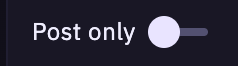
Post only is an extra order option. If enabled and the limit order would immediately take liquidity, it is cancelled. It does not guarantee a fill. The pictured switch is off.
Source: Kraken’s order-options guide · Reviewed: 2026-09-05 (UTC)
An interface detail published in official help, not a CoinNav account test. The document was updated on 2025-04-02; its image may be older. Use it to recognize the option, and check your account for its current location and supported order types.
A limit order is not automatically a maker order
A limit price that allows immediate execution can result in taker treatment. Kraken explicitly explains this distinction and notes that a post-only limit order can be cancelled if it cannot be placed as a maker. Kraken’s explanation
Before comparing rates, identify how you intend to execute. An unfilled order and a completed trade are different outcomes; the lower number in a table should not make you ignore execution conditions.
Compare the same product and account tier
Check the product, account tier, eligible pairs and maker/taker columns in a CoinNav fee table. Comparing an ordinary spot taker rate with a special-tier maker rate is not a consistent basis for choosing a platform.
Base rates exclude any funding, FX or withdrawal charges not listed. When a record expires, consult the official schedule rather than treating the old number as a current quote.
Check after execution
Use the platform’s order record to inspect executed notional, fee currency, fee tier and order role. If something differs from your expectation, ask the platform with the order reference. Do not send full account screenshots or credentials to CoinNav.
Read the full-cost guide or return to comparison.
One order can have two execution roles
The portion of a limit order matched immediately may be taker. A remainder that rests on the book and is matched later may be maker. Check the notional and role of each fill instead of assigning one label to the entire order. Unfilled quantities do not incur a trading fee charged on execution.
Kraken’s limit-order guide and order options support this mechanism; account rates require a separate check.